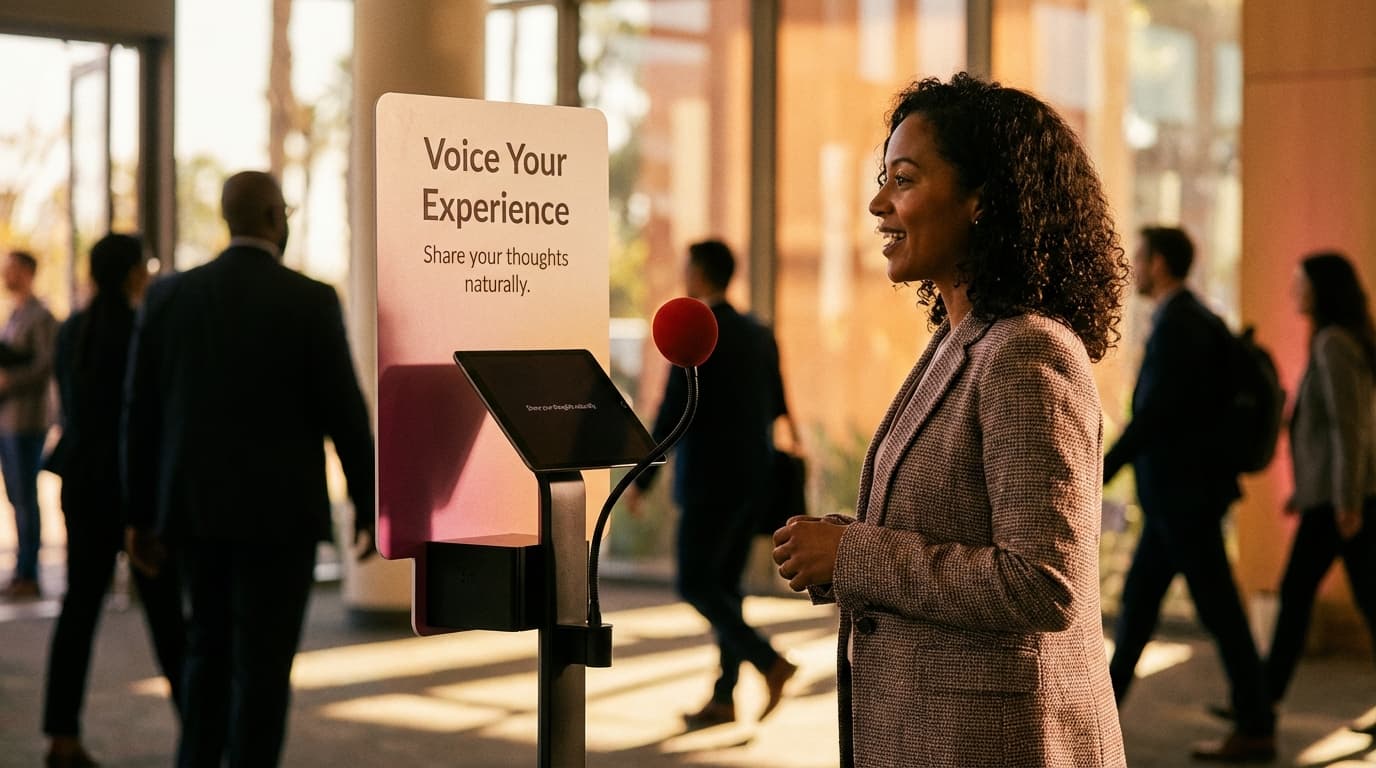
When an event ends, most attendees walk out the door. Within hours, the emotional resonance of their experience fades. By the time an email survey arrives three days later—delete. That’s the fundamental problem with post-event feedback: it’s collected too late, and the response rate reflects how much people care (which isn’t much).
The best event feedback isn’t collected after the event. It’s collected during it—ideally within minutes of attendees leaving your session, expo floor, or venue. At that moment, their experience is fresh. Their opinions are raw. Their answers mean something.
This guide covers the questions that matter, why they matter, and—crucially—how to actually collect them while attendees are still present and engaged.

Why Traditional Event Surveys Fail
Let’s be honest: nobody loves surveys. Post-event email surveys get opened by perhaps 5–15% of attendees. Of those, only a fraction complete the full survey. And the respondents who do answer are self-selected—usually either extremely satisfied or extremely frustrated, which skews your data.
Paper surveys fare slightly better because they’re immediate, but they’re labor-intensive to analyze and impossible to aggregate in real time. By the time you’ve compiled results from 200 paper forms, the event is old news and you can’t course-correct for your next session.
The gap between event quality and feedback quality has widened as venues and event organizers have become more sophisticated. You might spend months planning an event, but spend minutes collecting feedback about it. That imbalance costs you actionable insights.
In-the-moment feedback—collected at exits, via quick interactions—captures honest responses while attendees are still physically present and emotionally engaged. It also enables real-time operational adjustments for multi-day events.
10 Essential Event Feedback Questions (and Why They Work)
Your survey questions should answer three core questions: Did attendees enjoy this? What worked? What broke? Here’s a breakdown of high-impact questions grouped by category.
Satisfaction & Overall Experience
1. “How would you rate your overall experience today?” (1–10 scale)
This is your headline metric. It’s fast, memorable, and gives you an immediate gut check. The beauty of a 1–10 scale is that respondents understand it intuitively (unlike 1–5 scales which feel cramped). Track this as your primary KPI across events.
Insight: A shift from 7.2 to 7.8 average suggests your tweaks are working. A drop tells you something broke.
2. “What was the highlight of your time here?”
This is open-ended and qualitative. It costs you more to analyze (you need human review or AI transcription), but it tells you what actually resonated. Maybe your keynote speaker was exceptional. Maybe the networking lounge was the real draw. Maybe the coffee was surprisingly good.
Insight: Patterns in highlights show you what to double down on. If 30% mention the speaker and 5% mention the venue, your speaker budget is paying off.
3. “Would you recommend this event to a colleague?” (Yes/No or NPS variant)
This is your Net Promoter Score (NPS) proxy. It’s a forward-looking indicator of success. If 70% would recommend it, you’re in good shape. If 40% would, you have a credibility problem.
Insight: Responders who say “No” are goldmines. Follow up with them (see question 4) to understand the blockers.
Logistics & Experience Barriers
4. “Was there anything that frustrated you today?”
Open-ended question. This catches operational issues: Was parking a nightmare? Were the toilets difficult to find? Was the WiFi unusable? Was the venue too hot? These seem like small details, but they accumulate.
Insight: If 40% mention “WiFi didn’t work,” that’s a technical investment you need to make before the next event.
5. “How easy was it to navigate the venue?” (1–5 scale)
This specifically targets wayfinding. Poor signage, confusing layouts, and unclear room locations all degrade the experience. Many event organizers miss this because they know where everything is. Attendees don’t.
Insight: Scores below 3.5 mean you need signage, a better app, or clearer pre-event comms.
6. “Were the logistics (timing, schedule, accessibility) clear?”
This captures organizational clarity. Were sessions starting on time? Was the schedule easy to follow? Were accessibility features actually available?
Insight: A consistent issue here means your pre-event communication needs work, or your event operations are under-resourced.
Content & Programming Quality
7. “How relevant was the content to your role/interests?”
This tells you whether you’re serving your audience or trying to be all things to all people.
Insight: Low relevance scores might mean your speaker selection is off, your marketing is attracting the wrong crowd, or your content tracks are poorly differentiated.
8. “What topics would you like to see at future events?”
Future-focused question. This is your R&D input for next year’s event. People will tell you what they want if you ask.
Insight: Patterns here are your roadmap. If 50 people mention “AI and workplace productivity,” that’s your keynote for 2025.
9. “Which session or speaker was most valuable to you?”
If you run multiple concurrent sessions, this tells you which speakers earned their slot and which didn’t. It also helps you structure future agendas around high-performing themes.
Insight: If one speaker gets 5x more mentions than another, future scheduling and speaker budgets should reflect that.
Engagement & Community
10. “Did you make meaningful connections here?”
Networking value is a hidden driver of event attendance. People come for the content but often value the connections most. This question captures that.
Insight: If <30% say yes, your networking infrastructure (lounges, structured mixers, table seating) needs redesign.
11. “How would you describe this event to a friend?” (Open-ended)
This is a less formal version of the NPS question, but phrased conversationally. You’ll get colorful, authentic language that tells you the emotional resonance of your event.
Insight: Words like “inspiring,” “chaotic,” “boring,” or “energetic” tell you not just whether people liked it, but how they felt.
Advanced Questions (For Specific Event Types)
12. “Did this event justify the cost/time away from the office?”
ROI question. For paid events or high-stakes conferences, attendees are making a trade-off. Did you deliver value proportional to that cost?
Insight: If <60% agree, your ticket price is too high, or your content delivery didn’t match expectations.
13. “Will you attend again next year?”
Retention metric. Easier to keep existing attendees than recruit new ones. A drop in repeat attendance is an early warning sign.
Insight: Track year-over-year. A decline suggests competitive threats or declining perceived value.
14. “Which aspect of the experience could we improve most?”
Specific improvement focus. This is directional input for prioritization.
Insight: If most responses focus on a single area, that’s your priority.
15. “Any other feedback?”
Catch-all. Always include this. Some of your best feedback will come from here—things you never thought to ask about.
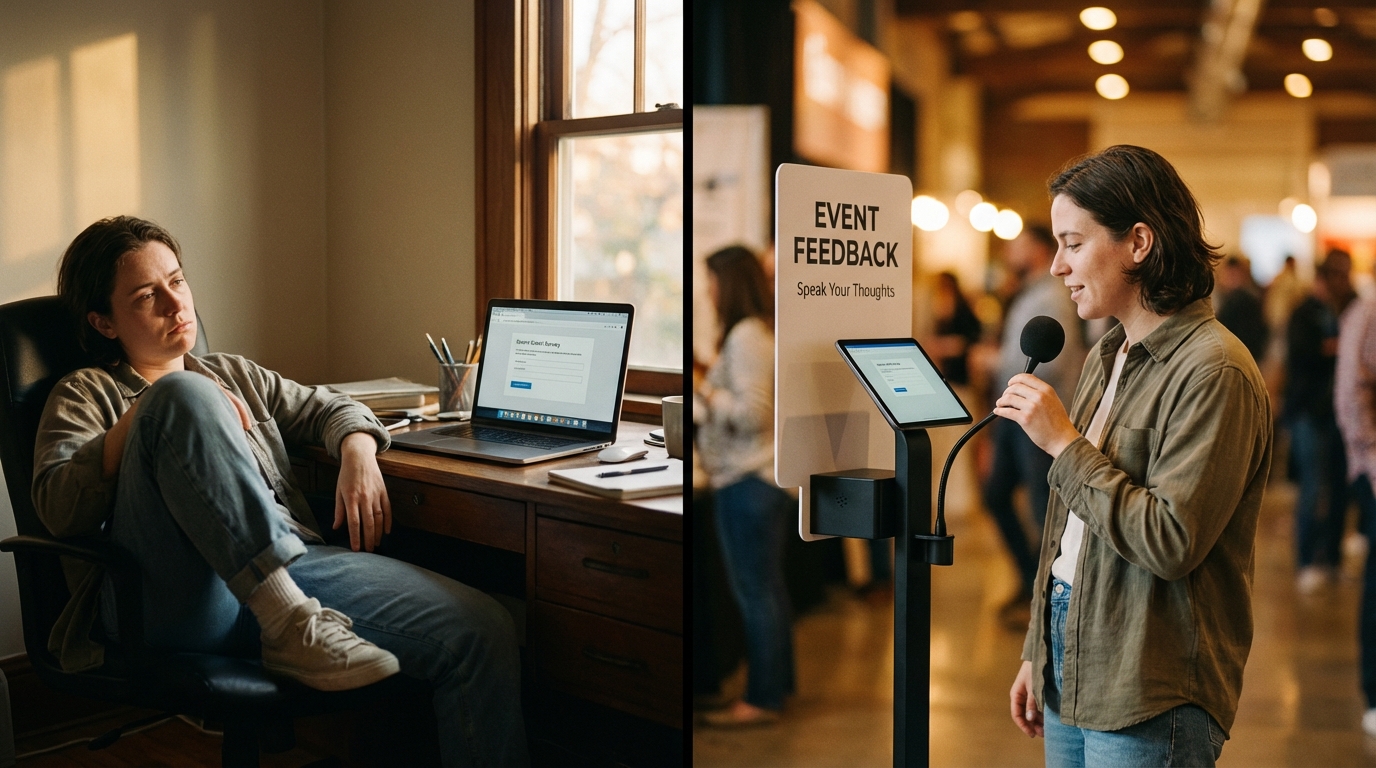
How to Collect Event Feedback: Methods Compared
Now that you know what to ask, the question becomes: how do you actually collect these responses while people are still at your event?
Email Surveys
How it works: Post-event, you email attendees a survey link.
Pros: Cheap and scalable, easy to set up, good for detailed written feedback.
Cons: Extremely low response rates (5–15%), significant time lag, response bias, no real-time insights.
Verdict: Useful as a secondary channel, but not your primary feedback mechanism.
Paper Surveys
How it works: Clipboard with printed survey at event exit or during networking.
Pros: Immediate collection, no technology barriers, higher response rates than email.
Cons: Illegible handwriting, labor-intensive to analyze, impossible to aggregate in real time.
Verdict: Better than email, but increasingly obsolete given better alternatives.
Online Tablets & Kiosks
How it works: Attendees complete a digital survey on a tablet or standing kiosk.
Pros: Real-time data capture, instant analysis, branching logic, professional appearance.
Cons: Upfront hardware cost, requires power and WiFi, physical space needed.
Verdict: Strong choice for events with 500+ attendees or recurring events.
QR Code Surveys
How it works: Attendees scan a QR code and complete a survey on their own phone.
Pros: Zero hardware cost, attendees use own device, instant digital responses.
Cons: Requires phones with cameras, depends on visible signage, lower rates if discovery is poor.
Verdict: Excellent for younger attendees; less effective for older demographics.
Voice-Powered Feedback
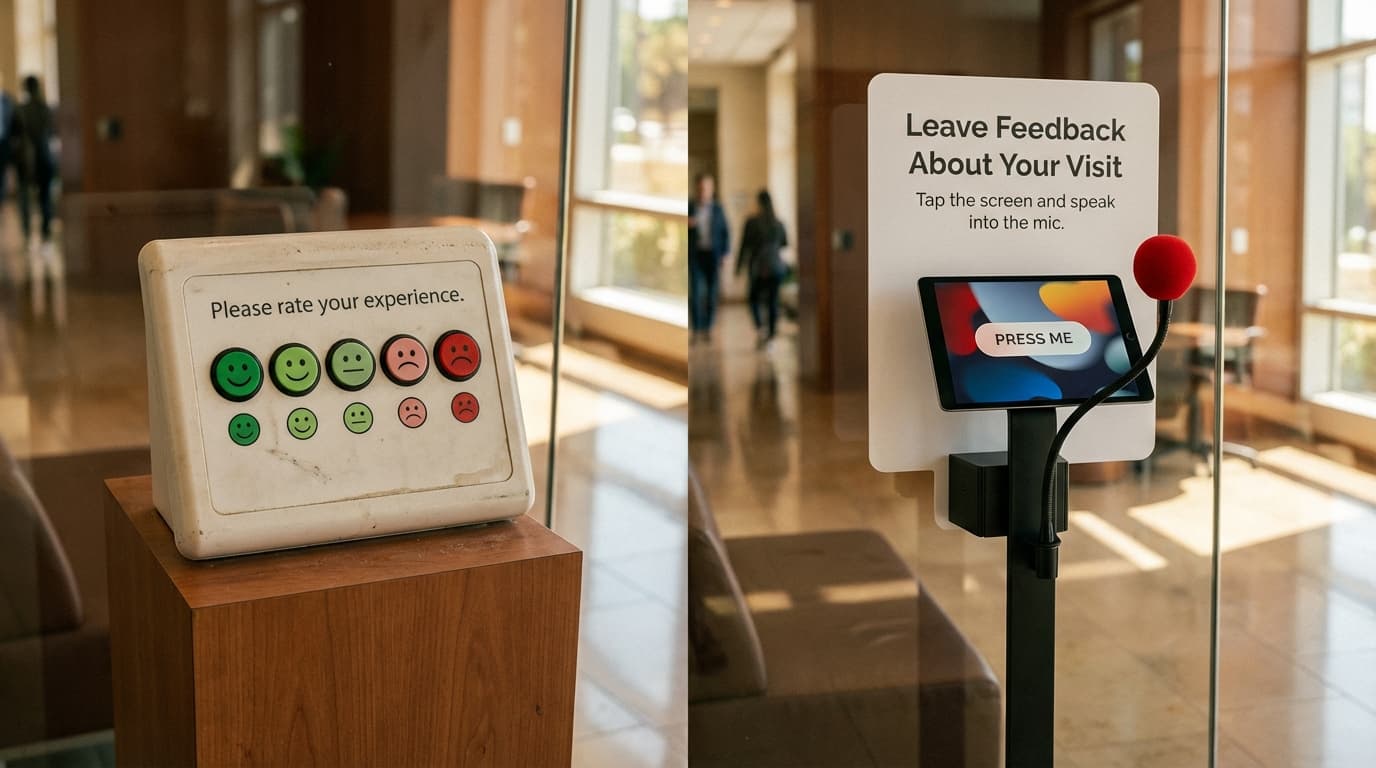
How it works: Attendees speak their feedback into a kiosk or call a phone number. AI transcribes, translates, and analyzes responses in real time.
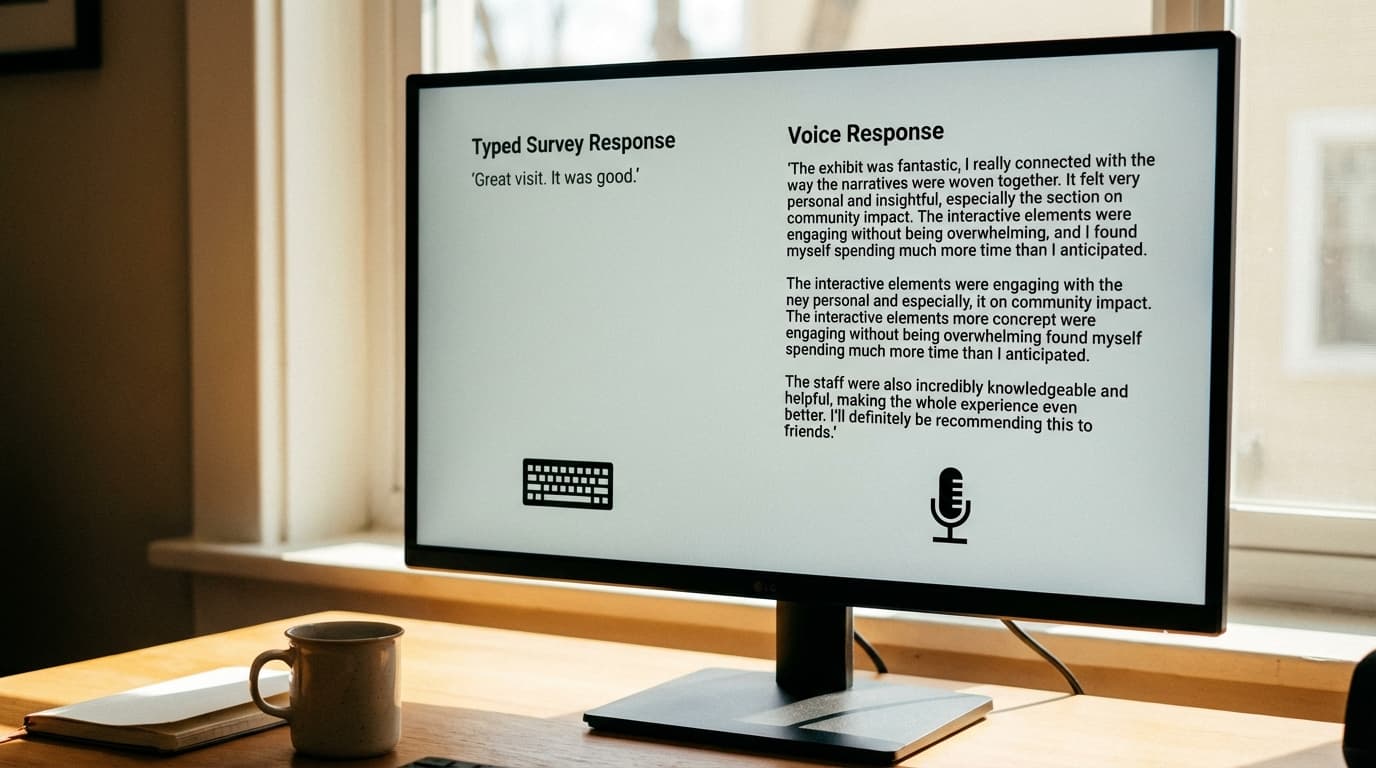
Pros: Fastest collection method, natural conversational tone, multilingual transcription and translation, highest engagement rates, real-time sentiment analysis, accessible, captures tone and emotion, rich qualitative data.
Cons: Upfront cost similar to tablets, privacy considerations, requires WiFi, less suitable for noisy environments.
Verdict: Best overall for event feedback, especially when real-time insights and multilingual support matter.
Practical Implementation Guide
Before the Event
- Choose your questions based on your specific event type and KPIs.
- Decide on collection method—or use a hybrid approach (QR + voice kiosk).
- Test the technology in your venue.
- Train your staff on how to encourage participation without being pushy.
- Set up analytics—decide what metrics matter to you.
During the Event
- Place collection points strategically—at exits, near networking areas, at session endpoints.
- Make collection visible—use signage, staff ambassadors, announcements.
- Keep it quick—surveys longer than 3 minutes see completion drop-offs.
- Offer incentives if appropriate.
- Monitor in real time—fix issues during the event.
After the Event
- Analyze within 24 hours while the event is still fresh.
- Share results with stakeholders and operations teams.
- Follow up on concerns.
- Plan for next event—use insights to adjust schedule, speaker selection, logistics, or venue choice.

Why Real-Time Matters
The difference between post-event email surveys and in-the-moment feedback collection is the difference between a rearview mirror and a windshield. Email surveys tell you what you did wrong; in-the-moment feedback lets you fix it while people are still there.
If you’re running a multi-day conference and 200 people on Day 1 mention “Session started 30 minutes late,” you can adjust operations for Day 2.
Moreover, real-time feedback builds a better attendee experience. People feel heard and valued when you’re actively soliciting their input now—not three weeks later.
Choosing Your Collection Method
- Small event (<100 attendees): QR code survey. Low cost, high engagement, minimal setup.
- Recurring events or 500+ attendees: Voice-powered kiosk or tablet.
- Multilingual or international attendees: Voice kiosk with real-time translation.
- Tech-forward conference: Hybrid approach—QR codes + voice kiosk + real-time dashboard.
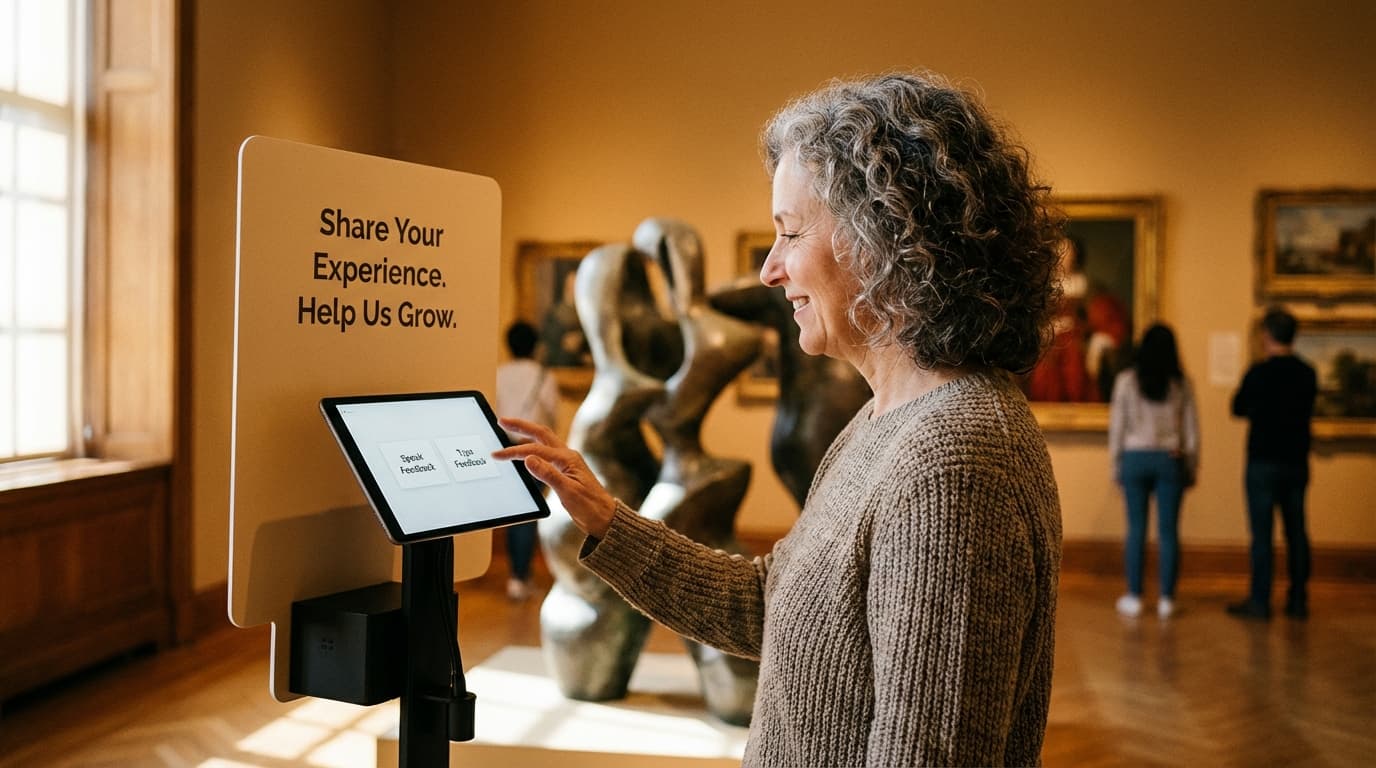
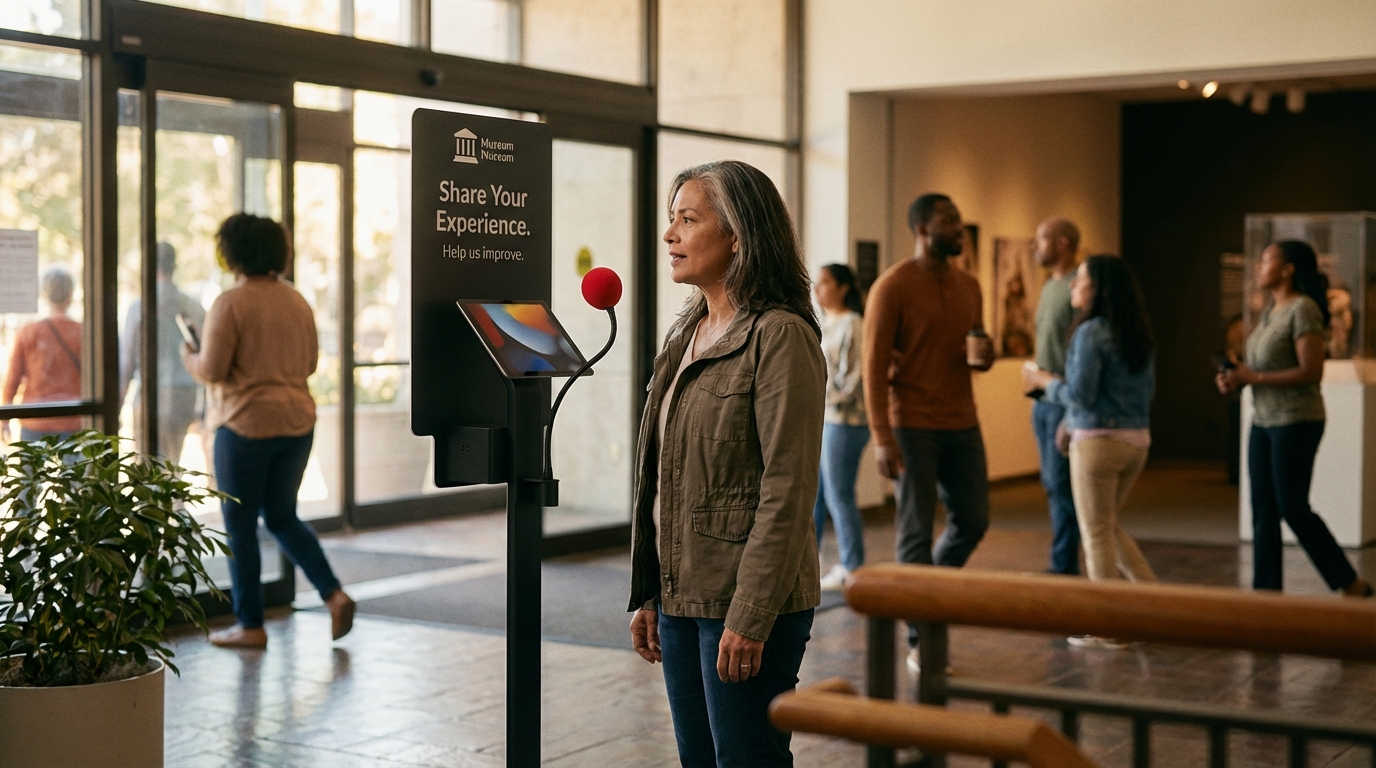
- Museum, attraction, or venue: Voice kiosk at exit.
Whether it’s voice kiosks for events or QR-based feedback for attractions, the technology should disappear—the goal is feedback that actually informs decisions.
Key Takeaways
- In-the-moment feedback beats post-event email surveys. Capture responses while attendees are still present.
- Ask questions that align with your actual KPIs.
- Use open-ended questions to understand why.
- Choose your collection method based on your venue, audience, and budget.
- Act on feedback in real time.
- Aim for quality over quantity. 100 detailed, honest responses beat 500 thoughtless multiple-choice answers.
Events will always be chaotic. But feedback doesn’t have to be. Real-time, voice-powered feedback collection transforms attendees from passive participants into active advisors.
Ready to capture real-time event feedback? Explore how voice feedback transforms event insights, or request a demo to see how SaySo works at your next event.